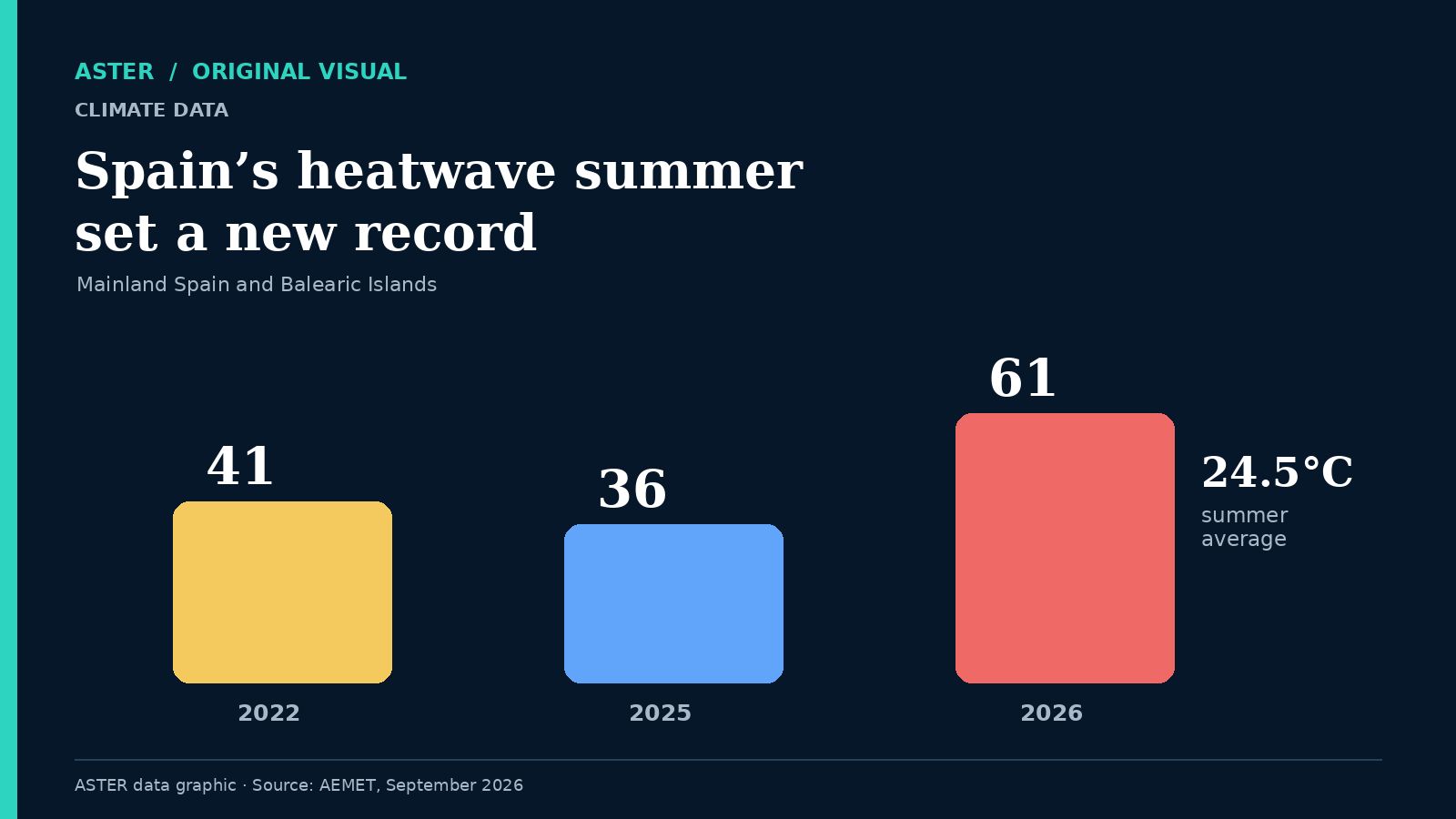
Spain recorded 61 heatwave days across the mainland and Balearic Islands in 2026, the highest total in the country’s official series, according to the national weather agency AEMET. The figure means that roughly two days in every three during the meteorological summer met the agency’s heatwave criteria somewhere in that territory.
The record was not produced by one isolated episode. AEMET identified four heatwaves between June and early September on the mainland and Balearics, including two exceptionally long events in July and August. The Canary Islands experienced a separate five-day heatwave in August.
Spain’s average summer temperature reached 24.5C, AEMET said, making 2026 the hottest summer in records dating to 1961. It was 0.3C warmer than the previous record set in 2025 and 2.4C above the 1991-2020 seasonal average.
Four episodes, one record-breaking season
The first heatwave ran from June 20 to June 27 and affected 42 provinces. A second episode lasted 23 days, from July 2 to July 24, with an average temperature anomaly of 3.9C across the affected area. It reached 37 provinces.
After only a short break, another heatwave began on July 28 and continued for 24 days, through August 20, affecting 32 provinces. A fourth event, provisionally dated from September 2 to September 7, reached 16 provinces.
Together, the episodes produced 61 heatwave days on the mainland and Balearics, compared with the previous annual record of 41 days in 2022. The 36 days recorded in 2025 had ranked second before this year.
The duration is significant because long heat events leave less time for buildings, water systems, health services and workers to recover. Night-time temperatures are also important: even when daytime peaks ease, persistent heat after sunset can prevent homes and cities from cooling.
What AEMET counts as a heatwave
The term is often used loosely, but AEMET applies a specific statistical definition. An episode must last at least three consecutive days, affect at least 10% of the weather stations in the reference area, and push maximum temperatures above a locally defined threshold.
That threshold is the 95th percentile of each station’s daily maximum temperatures for July and August during the 1971-2000 reference period. In practical terms, the benchmark changes from place to place. A temperature that is exceptional in one province may be normal in another.
This method also explains why the 61-day total does not mean every part of Spain experienced heatwave conditions on each of those days. It means the national criteria were met across a sufficient share of stations somewhere in the mainland-Balearic monitoring area.
The longer trend
The 2026 season extends a clear pattern in Spain’s temperature record. AEMET says the country’s 10 warmest summers have all occurred in the 21st century, and seven of the eight hottest have been recorded since 2015.
No single season, on its own, establishes the cause of climate change. The long-term rise in the frequency and intensity of extreme heat, however, is consistent with the well-established effect of greenhouse-gas-driven warming: a warmer baseline makes episodes at the hot end of the distribution more likely and more severe.
For Spain, the consequences go beyond peak readings on thermometers. Prolonged heat raises electricity demand, dries vegetation, increases pressure on water supplies and reduces labour productivity in outdoor and poorly cooled workplaces. It also magnifies the urban heat-island effect, particularly in dense neighbourhoods with little shade.
From emergency response to adaptation
Heatwave warnings are designed to reduce immediate risk, but a season with 61 qualifying days tests measures that were built around shorter emergencies. Schools, hospitals, care homes, transport operators and employers increasingly have to plan for heat as a recurring operational condition.
Local adaptation can include shaded public spaces, more trees, reflective roofs, building retrofits, cooling centres and work schedules that avoid the hottest hours. Water planning and wildfire prevention also become harder when intense heat persists for weeks rather than days.
The data do not mean every solution is equally effective everywhere. Coastal humidity, elevation, housing quality and access to cooling vary sharply across Spain. Policies therefore need local temperature and vulnerability data, not only national averages.
What to watch next
AEMET described the September event as provisional, so the final annual assessment could refine dates or affected areas after quality control. Autumn rainfall will also determine how much of the summer’s stress carries into reservoir levels, agriculture and wildfire conditions.
The larger question is whether 2026 is an outlier above a rising trend or a preview of summers that will become more common. Spain’s recent record sequence makes the distinction increasingly important for infrastructure and public spending: systems designed around historical averages may no longer match the conditions they are expected to withstand.
Sources and methodology
ASTER used AEMET’s September 2026 heatwave bulletin as the primary source for temperatures, dates and definitions, and cross-checked the figures against reporting by Reuters and Euronews. The 61-day measure refers to the mainland and Balearic monitoring area; the Canary Islands are assessed separately by AEMET.