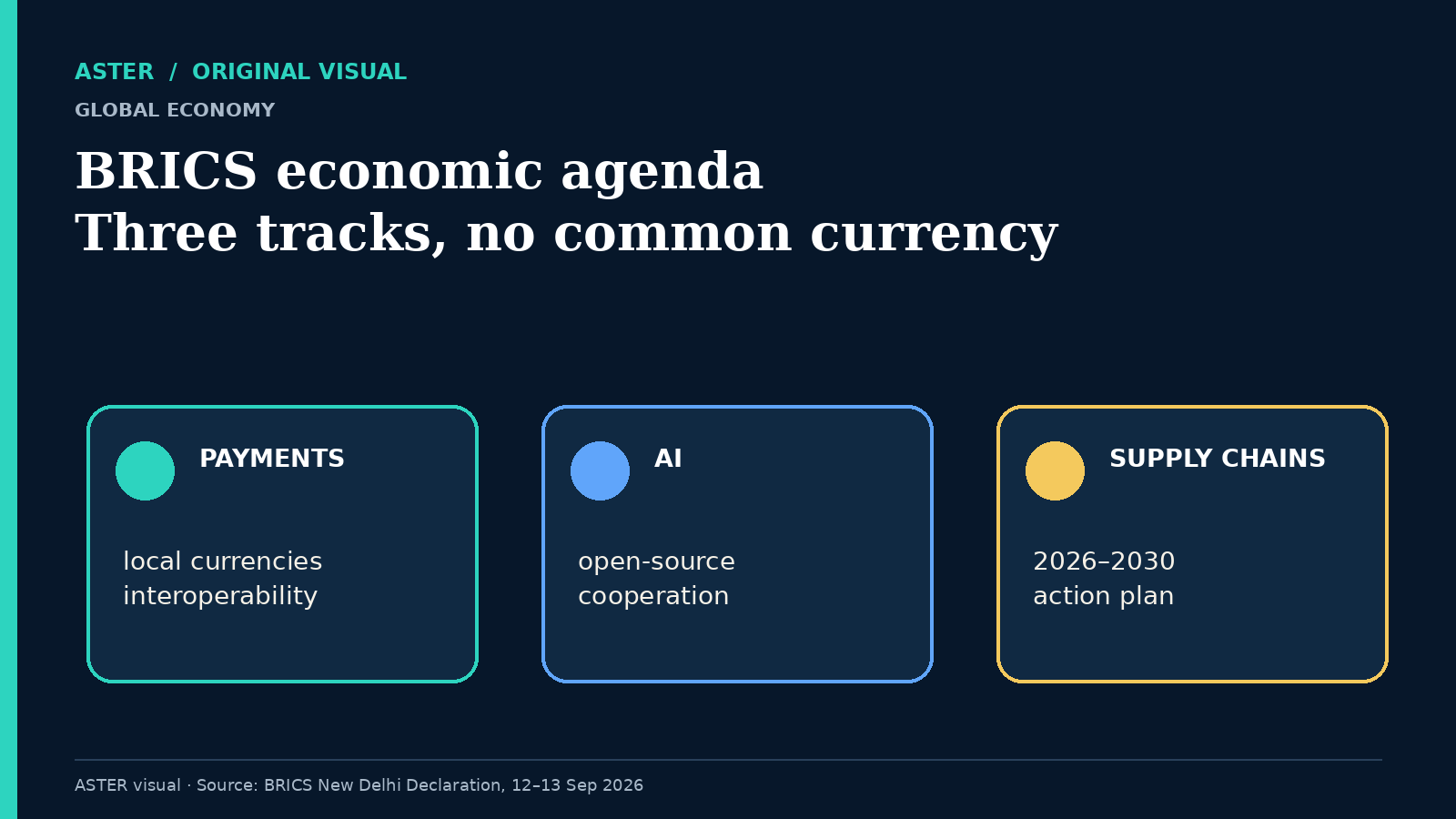
China used the BRICS summit in New Delhi to press for deeper economic coordination across the expanded bloc, proposing a shared artificial-intelligence initiative and closer links in services, industrial supply chains and special economic zones. The summit’s joint declaration also placed cross-border payments and trade in local currencies on the group’s work programme, while stopping short of announcing a common currency or a single payment network.
The package emerging from the September 12-13 meeting illustrates both the ambition and the limits of BRICS. Its 11 full members represent a large share of the world’s population and economic output, but differ sharply in their political systems, security interests and exposure to the US dollar. The New Delhi declaration therefore mixes concrete technical projects with commitments that still require negotiation.
What Xi proposed
Chinese President Xi Jinping called for an “AI Open Source Zone” and a partnership among special economic zones, according to remarks reported from the summit. He also proposed a BRICS forum on trade in services in 2027 and urged members to make supply chains more resilient.
Those ideas sit alongside a broader set of collective commitments agreed by the group. The declaration endorsed a BRICS Economic Partnership Strategy running to 2030 and an action plan for cooperation on global value chains from 2026 to 2030. It also backed closer work on digital trade, standards, customs and small and medium-sized companies.
The distinction matters. Xi’s initiatives are Chinese proposals to the bloc; the declaration is the negotiated position of all members. Neither category amounts, by itself, to a funded institution or a binding treaty.
India chaired this year’s summit and China is due to take over the rotating presidency in 2027. That sequence gives Beijing an opportunity to carry some of its proposals into the next annual cycle, but implementation will depend on whether other members agree on governance, financing and access.
Payments remain the most sensitive economic file
The summit again highlighted efforts to make cross-border transactions cheaper and less dependent on a small number of financial channels. The declaration said a BRICS task force would continue examining payment mechanisms and welcomed greater use of local currencies in trade and investment where members choose to do so.
The language is incremental. It does not create a BRICS currency, and it does not require national central banks or commercial banks to join a uniform system. Instead, the work is focused on interoperability, settlement options and the practical barriers that companies face when paying suppliers across borders.
That cautious approach reflects a basic tension inside the group. Members have a shared interest in reducing transaction costs and their vulnerability to external financial pressure. But their currencies differ widely in convertibility, liquidity and inflation history, while regulators apply different controls to capital flows.
The declaration also referred to continued study of a possible new investment platform and welcomed the creation of a BRICS Risk Lab at India’s GIFT City financial centre. These are building blocks rather than a single financial architecture.
A bigger bloc with a harder coordination problem
BRICS began as Brazil, Russia, India, China and South Africa and has since expanded to include Egypt, Ethiopia, Iran, the United Arab Emirates and Indonesia among its full members. The larger format gives the group more demographic and diplomatic weight, but also makes consensus more complicated.
The New Delhi meeting demonstrated that breadth. Its declaration covered trade, development finance, artificial intelligence, public health, climate, urban policy, scientific cooperation and reform of international institutions. Indian Prime Minister Narendra Modi argued that the bloc should help build resilience at a time of geopolitical tension, disrupted supply chains and economic uncertainty.
For businesses, the near-term test will be whether the summit produces operational changes: common technical standards, customs simplification, usable payment connections or new financing. Broad declarations can set direction, but companies benefit only when ministries, central banks and regulators translate them into rules and infrastructure.
Why the AI proposal is strategically important
Artificial intelligence has become an industrial-policy issue as much as a technology issue. Access to computing power, chips, models, data and skilled workers is uneven across BRICS members. An open-source cooperation zone could lower some software barriers and create channels for joint research, but it would also raise questions about cybersecurity, data governance and the control of shared infrastructure.
The declaration separately supported a BRICS repository for science and research and stronger cooperation among universities and innovation centres. Taken together, these commitments suggest that members want to build research links that are less dependent on institutions based in North America and Europe.
Whether that effort becomes a durable network will depend on detailed rules. Open-source models can be distributed widely, but advanced AI development still relies on costly hardware, reliable energy supplies, specialised talent and access to large datasets. Those constraints cannot be resolved by a summit statement alone.
What happens next
The next stage will take place in working groups, ministerial meetings and the New Development Bank rather than at leaders’ summits. Officials must define the AI initiative, decide how the special-economic-zone partnership would operate and continue technical work on payments and investment.
China’s 2027 chairmanship gives it agenda-setting influence, but not unilateral control. India, Brazil, South Africa and other members have their own priorities and guard their policy autonomy. The measure of the New Delhi summit will therefore be the number of proposals that survive that bargaining process and become usable programmes before leaders meet again.
Sources and methodology
ASTER reviewed the official 140-point BRICS New Delhi Declaration published by the Indian prime minister’s office, contemporaneous reporting by Reuters and Associated Press, and Reuters’ September 15 assessment of the summit’s economic balance. Proposals attributed to individual leaders are distinguished from measures adopted collectively.